Why does MusicXML show more notes than my MIDI?
Check for a tie across a barline before deleting a note. One sustained MIDI note can appear as two noteheads connected by a tie. Keep the MIDI if you want the original performance timing; use MusicXML to edit how the rhythm is written.
Open the MP3 to MIDI converter
Follow four notes from MIDI to MusicXML
We made a single-track MIDI at 120 BPM and imported it into Audiomidi Studio. The whole-song MusicXML download uses four divisions per quarter note. The input starts below are beats elapsed from the start of the file, calculated from the MIDI at 120 BPM. The score starts come from adding its written durations and rests.
| MIDI note | Original start | Score start |
|---|---|---|
| C4 | 0 | 0 |
| E4 | 0.58 | 0.50 |
| G4 | 1.52 | 1.50 |
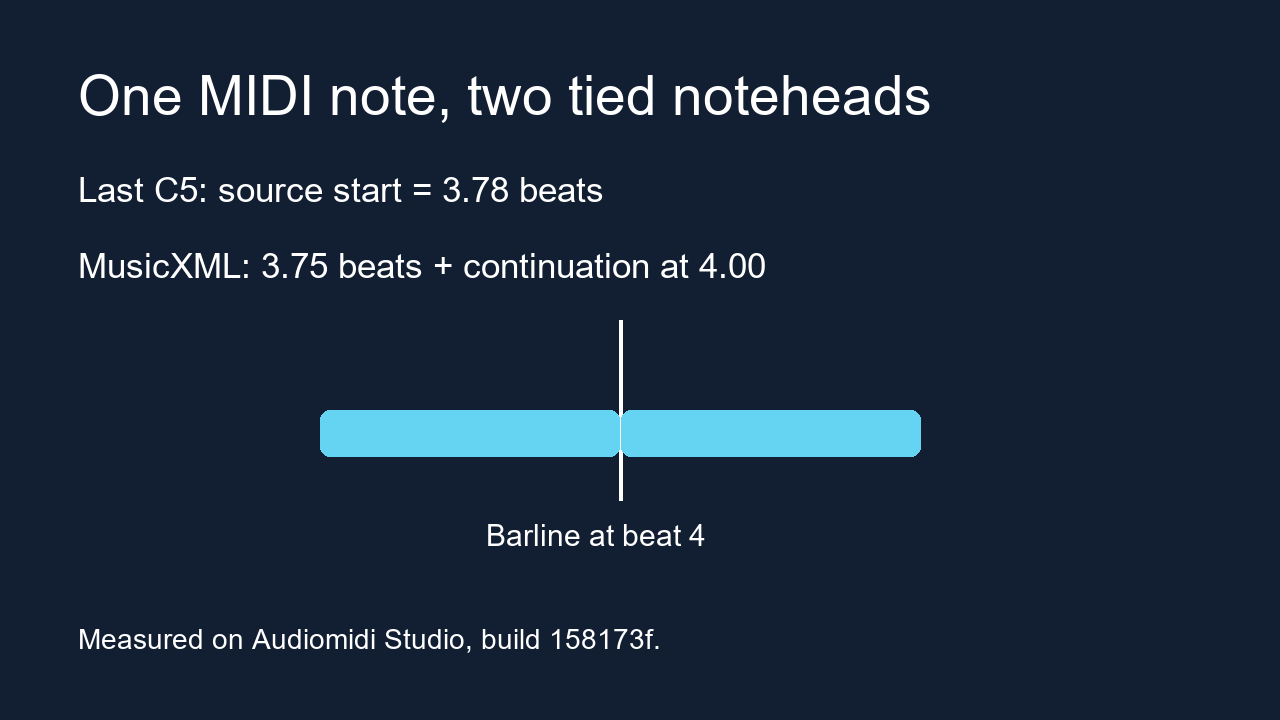
| C5 | 3.78 | 3.75, then 4.00 (tied) |
E4 starts 0.08 beat earlier on the written grid and shrinks from 0.36 to 0.25 beat. The last C5 crosses the barline and appears as two sixteenth notes, each 0.25 beat long. The first has a tie start and the second a tie stop. That is one sustained event represented with two noteheads, not a second attack.
The MusicXML file did not contain an explicit playback tempo. Compare the score in beats first. The 120 BPM value belongs to the MIDI fixture and should not be assumed to carry through to every notation reader.
Download the original MIDI · Download the actual MusicXML export
What should I check before editing?
Open the original MIDI and the score side by side. Check the note starts against the grid and follow any ties across barlines. If a score looks simpler than the MIDI, check the durations as well as the pitches: rounding can change the written rhythm without changing the note name.
For a clip that shifts against the recording, use the separate timing check. This example concerns the score representation of an existing MIDI, rather than the alignment of an audio conversion.
If the note names change between sharps and flats, compare the separate pitch-spelling experiment before changing the pitch.
Is this a test of MP3 transcription accuracy?
No. The input was a controlled MIDI, so the comparison isolates the notation export. If you started with an MP3, verify the detected notes against the recording before deciding whether to edit the MIDI or only the score.